
There is a distinct, undeniable gravity to picking up a Hasselblad 500C/M. It does not invite you to snap a photo; it demands that you craft an image. In an era where digital sensors process millions of pixels in a fraction of a millisecond, returning to a purely mechanical medium format camera feels less like a step backward in technology and more like a step forward in intentionality. This Hasselblad 500C/M review is not about measuring lines of resolution or frames per second. It is an exploration of friction, geometry, and the visceral ritual of analog photography.
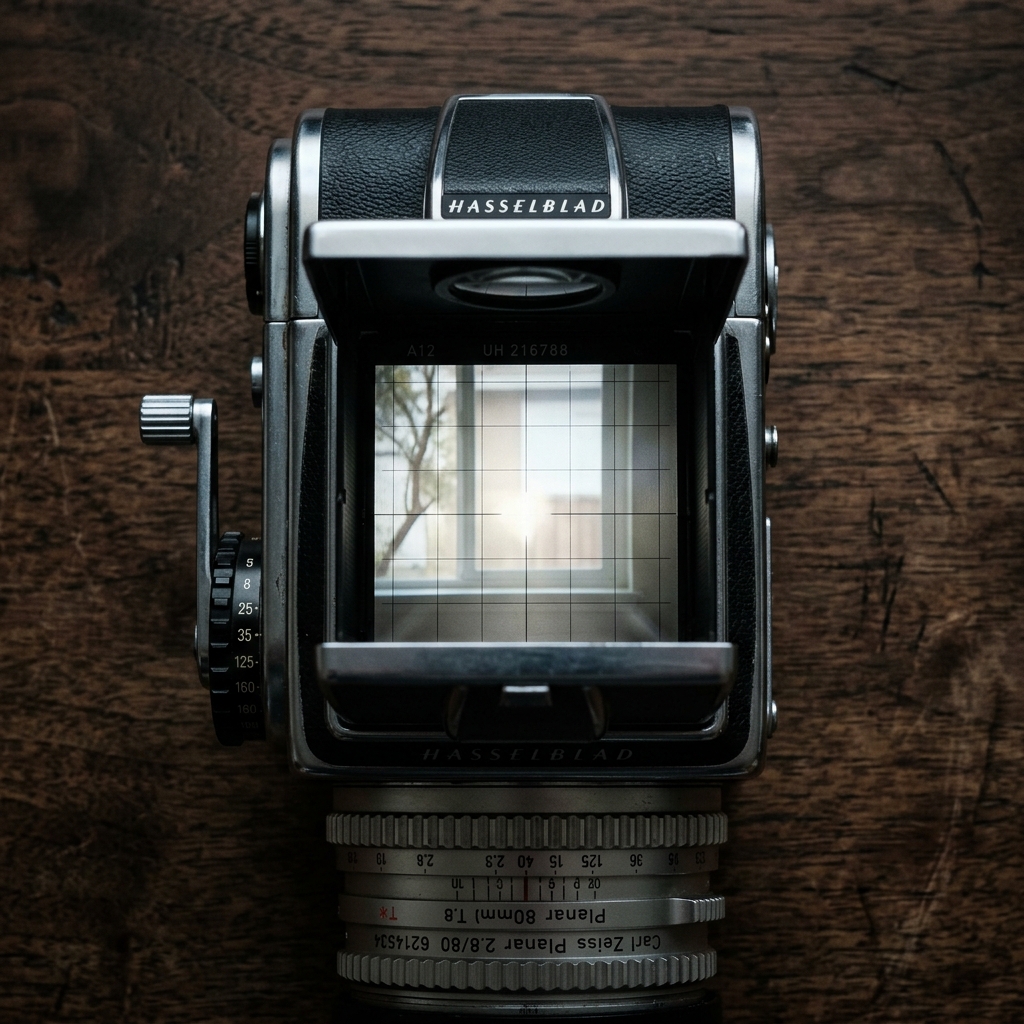
The Weight of Intention: Anatomy of a Swedish Masterpiece
To hold the 500C/M is to hold a dense, metallic monolith. Introduced in 1970 as a refined evolution of the original 500C, the camera is stripped of ergonomic comforts. There are no molded grips, no rubberized thumb rests—only a brutalist cube of chrome and leatherette that feels purposeful and enduring.
Its modular nature—comprising the body, the film back, the viewfinder, and the lens—means that using the camera is an act of assembly. Every time you lock the Carl Zeiss lens into the mount or slide the dark slide from the A12 film back, you are engaging in a tactile dialogue with the machine. The tolerances are exact. The metal-on-metal friction is reassuringly heavy. It forces you to slow down, to acknowledge the physical reality of the photographic process before the shutter is even cocked.
The Physics of the Waist-Level Viewfinder
Perhaps the most defining characteristic of the 500C/M is its waist-level viewfinder. Looking down into the ground glass is not merely a change in ergonomics; it is a shift in photographic philosophy.
Because the viewfinder lacks a pentaprism, the world is presented to you laterally reversed. When your subject moves left, the projection on the glass moves right. This optical quirk disorients the beginner but eventually liberates the seasoned practitioner. The lateral reversal forces you to look at the scene as an abstract composition of shapes and light, rather than a literal translation of reality. You are no longer reacting to a moment; you are translating it.
Furthermore, shooting from the waist fundamentally alters your relationship with the subject. You are not hiding your face behind a black plastic box. You are bowing your head to the machine, maintaining an open, vulnerable posture that often disarms portrait subjects and yields a quieter, more authentic exchange.
The Decisive Clunk: Sound as a Metric of Quality
Photography is overwhelmingly a visual medium, yet the Hasselblad is an instrument defined by its sound. Pressing the shutter release on the 500C/M does not produce the discreet, electronic whisper of modern cameras. It initiates a violent, glorious mechanical symphony.
First, the massive secondary shutter flaps open, immediately followed by the mirror slapping upward with a definitive thwack. Then, the leaf shutter inside the lens fires, capturing the exposure before the mirror resets. It is a loud, percussive sequence that sends a subtle vibration through the palms of your hands. This is not a camera for stealth; it is a camera for declaration. Every frame exposed is an announced event.
Following the exposure, winding the crank to advance the film and recock the shutter requires a deliberate, muscular rotation. The sound of the gears meshing and locking into place is the auditory equivalent of a period at the end of a sentence. It provides closure to the act of capture.
The Discipline of the 6×6 Square Format
The 6×6 centimeter square format is a ruthless instructor. It strips away the crutches of horizontal or vertical orientation. You cannot rely on a sweeping landscape crop or a traditional portrait orientation to anchor the viewer’s eye.
The square demands balance. It thrives on symmetry, central framing, and strong leading lines. Composing in 1:1 requires a ruthless curation of the edges of your frame, forcing you to ask what is truly necessary for the image to survive. In return for this discipline, the square offers a profound sense of stillness and permanence. Images shot on the 500C/M often feel timeless, not just because of the film stock, but because the geometry of the square resists dynamic tension in favor of classical stability.
Glass and Grain: A Marriage of Optics and Chemistry
No review of this system is complete without addressing the glass. The Carl Zeiss Planar 80mm f/2.8 is a legendary piece of optical engineering. Wide open, it renders a subtle, painterly transition from focus to out-of-focus areas—a threedimensional “pop” that remains elusive to digital sensors. Stopped down, it resolves detail with clinical, yet soulful, precision.
When paired with a classic emulsion like Ilford HP5 Plus 400, the results are mesmerizing. The grain structure of the large 6×6 negative is fine but distinctly present, providing a textural foundation that makes the image feel like a physical object rather than a digital rendering. The medium format negative absorbs light differently, capturing an immense tonal range that preserves shadow detail and prevents highlights from artificially clipping.
The Weight of a Frame
To shoot with the Hasselblad 500C/M is to accept a set of beautiful limitations. You are bound by twelve frames per roll. You are burdened by its weight. You are challenged by its reversed viewfinder and its unforgiving format.
Yet, it is precisely these limitations that elevate the practice. The camera is not a tool of convenience; it is a tool of consequence. In an era where photography has become largely disposable—a rapid-fire stream of instant gratification—the Hasselblad 500C/M demands that we pause, look down into the glass, and decide if the moment in front of us is truly worth preserving. It is a masterclass in slow photography, and a reminder that true mechanical perfection is not about making the process easier, but making the result matter.