
There was a time when a point-and-shoot camera was an exercise in compromise. You traded optical perfection and manual control for the convenience of a camera that could slide unnoticed into a coat pocket. But in 1990, Kyocera fundamentally challenged that paradigm with the introduction of the Contax T2. It was billed not as a compromise, but as a distillation—a professional instrument masquerading as a tourist’s snapshot device.
Fast forward to 2026, and the landscape of analog photography has radically shifted. The Contax T2 has transcended its original purpose as a street photographer’s stealth companion. Propelled by celebrity endorsements, social media aesthetics, and the broader film photography bubble, the camera now regularly commands prices upward of $2,000. This Contax T2 review must therefore ask a difficult, necessary question: beneath the hype, the titanium shell, and the staggering price tag, does the camera remain a photographic tool, or has it become merely a luxury totem?
The Allure of Titanium and Glass
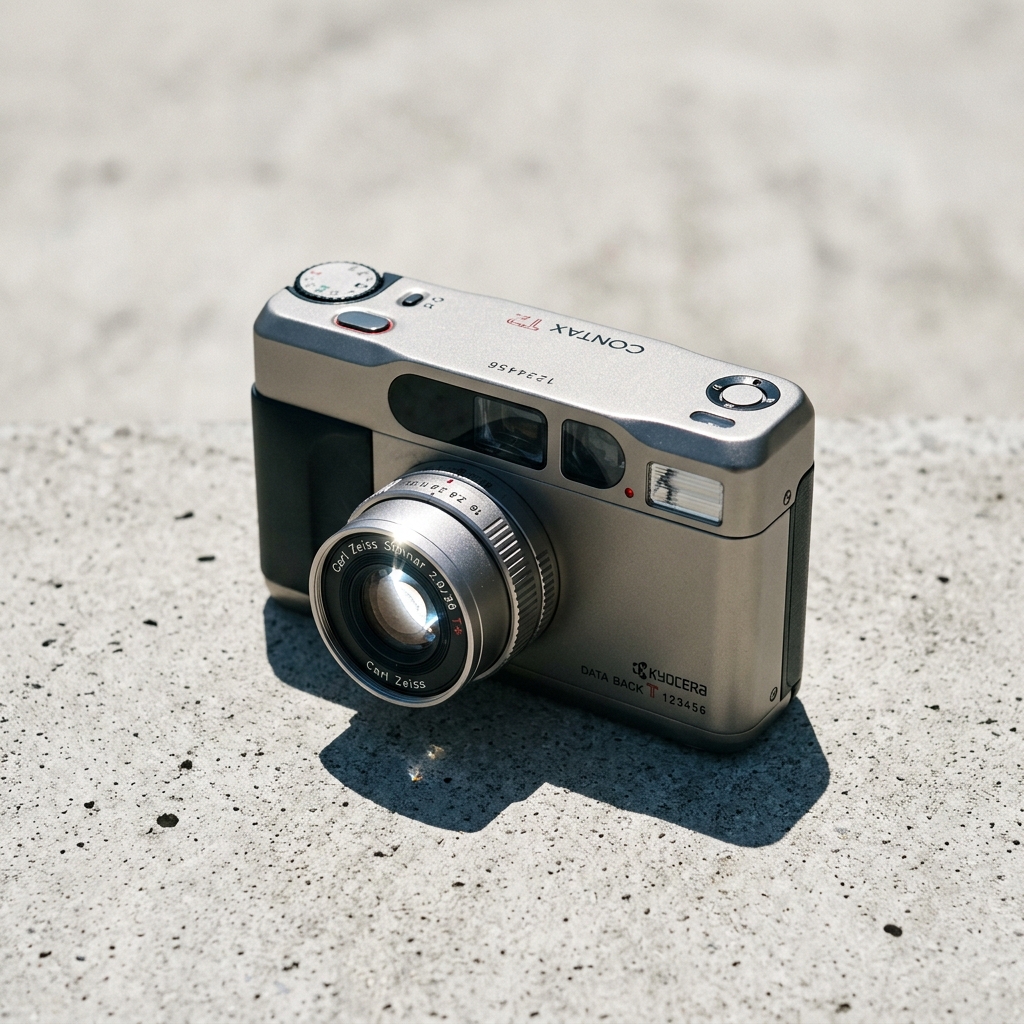
To hold the Contax T2 is to understand immediately why it is so coveted. It does not feel like a piece of consumer electronics; it feels like fine jewelry. The cold, dense weight of the titanium body communicates a sense of permanence that modern plastic and polycarbonate cameras simply cannot replicate. The dials click with a reassuring, mechanical resistance. The design is a triumph of late-twentieth-century industrial minimalism—elegant, understated, and brutally functional.
But the true genius of the T2 lies behind its protective cover: the Carl Zeiss Sonnar 38mm f/2.8 lens. With its legendary T* multi-coating, this lens delivers a level of micro-contrast, edge-to-edge sharpness, and tonal depth that rivals heavy SLR systems. Wide open, the Sonnar optical formula produces a signature rendering—a sharp center that gently falls off toward the corners, yielding portraits with an almost cinematic isolation.
When paired with a modern emulsion like Kodak Portra 400, the T2 renders skin tones with remarkable warmth and depth. The camera handles the heavy lifting—exposure, flash output, and film advance—allowing the photographer to remain entirely present in the moment. In its optimal state, the T2 removes the friction between the eye and the image.
The Flaws of Aging Electronics
However, evaluating the Contax T2 solely on its optical merits ignores the precarious reality of shooting with one today. Underneath that indestructible titanium armor lies a fragile nervous system of thirty-five-year-old electronics. And here is where the romance of the premium point-and-shoot begins to fracture.
Unlike a fully mechanical Leica or Hasselblad, which can be disassembled, cleaned, and lubricated back to perfection by a skilled technician, the Contax T2 relies on proprietary microchips and ribbon cables that are no longer manufactured. When the electronics fail—and eventually, they all do—the camera is often reduced to a devastatingly beautiful paperweight.
Furthermore, the technology of the 1990s betrays its age in use. The active infrared autofocus, while revolutionary at its release, is notoriously finicky by today’s standards. It frequently hunts in low light or unexpectedly locks onto the background rather than the subject. The shutter button’s half-press requires a dangerously delicate touch; press slightly too hard, and the camera fires prematurely, wasting a frame. To shoot with the T2 today is to accept a persistent, low-grade anxiety: the fear of missed focus, the dread of a dying battery, and the looming threat of an unrepairable electronic death.
From Tool to Totem: The Celebrity Markup
The most glaring issue with the Contax T2 is not its autofocus or its fragile circuitry, but its position in the cultural zeitgeist. When Kendall Jenner revealed her T2 on a late-night talk show nearly a decade ago, it initiated a seismic shift in the market. The camera was rapidly adopted by the fashion and influencer elite, transforming it from a niche photographic tool into a mainstream status symbol.
This cultural elevation created the premium point-and-shoot bubble. The camera’s current market value—often exceeding $2,000 for a pristine model—has entirely decoupled from its functional utility. You are no longer paying for a Zeiss lens and a titanium body; you are paying the entry fee to a specific aesthetic lifestyle.
For the working street photographer or the serious visual artist, this collector markup is fatal. A camera meant for spontaneous, uninhibited documentation becomes a liability when carrying it feels like carrying a fragile piece of fine art. When you are afraid to drop a point-and-shoot, it ceases to be a point-and-shoot.
The Verdict on the Hype
Is the Contax T2 a phenomenal camera? Undoubtedly. It represents a zenith in compact camera engineering, marrying premium materials with world-class optics. When it nails focus, the images it produces possess a distinct, undeniable magic that validates its legendary status.
But is it worth the hype in 2026? As a pragmatic photographic tool, the answer is no. The risk of electronic failure and the frustration of archaic autofocus systems cannot justify a price tag that could otherwise fund a professional digital system or a lifetime supply of film.
The Contax T2 has crossed the threshold from utility to luxury. It is a beautiful, flawed artifact of a bygone era. We should appreciate it for the images it has created and the design standard it set, but we must also recognize that true photographic value rarely aligns with a fashionable price tag. The best camera is the one you are not afraid to use, and for many, the T2 has become simply too precious to shoot.